

Powering a Sustainable Future
Offshore Wind Energy in Germany
TotalEnergies is one of the leading experts in offshore wind. With its know-how, the company successfully develops and operates offshore wind farms worldwide.
of Clean Offshore Wind Energy being developed by TotalEnergies in Germany
Offshore Wind Farms: High Performance and Efficiency at Sea
An offshore wind farm consists of several wind turbines at sea with capacities of 8–15 MW, delivering up to 4,500 full-load hours annually and offering advantages such as consistent power production, high efficiency, and fewer land-use conflicts. TotalEnergies is among the leading offshore wind experts and successfully develops offshore wind farms worldwide, including 7.5 GW of offshore capacity in Germany, contributing to the production of low-carbon electricity.
Our Projects in Germany
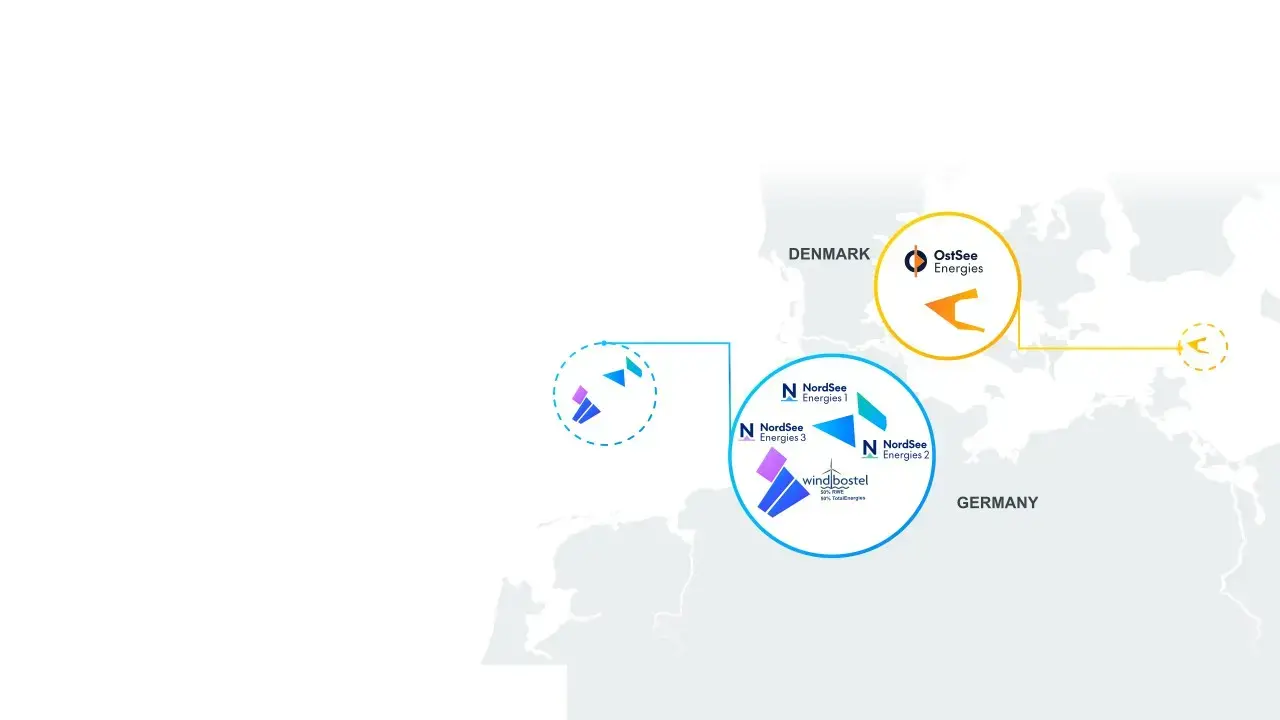

TotalEnergies, one of the largest developers of offshore wind farms in Germany, will make a significant contribution to the expansion of offshore energy in the coming years. Drawing on its expertise and capabilities, the company supports its ambition to generate 100 terawatt-hours of low-carbon electricity annually by 2030
MD Offshore Wind Germany at TotalEnergies
Advantages of Offshore Wind Energy
Offshore wind power offers numerous benefits. Companies, energy providers, and policymakers benefit from high efficiency, stable electricity generation, and extensive utilization opportunities.
High Efficiency and Consistent Power Generation
- Offshore installations achieve up to 4,500 full-load hours per year, while onshore installations average around 2,000 hours.
- The constant wind speeds at sea result in stable and predictable energy production, ideal for integration into national power grids.
Reduced Land-Use Conflicts & Utilization Opportunities
- Offshore wind farms occupy areas that are not used for agriculture or residential development.
- Synergies arise with fisheries, shipping, and other uses of marine spaces.
| Attributes | Offshore | Onshore |
|---|---|---|
| full-lead hours / year | up to 4500 | until 2000 |
| wind speed | high & steady | unsteady |
| space requirements | low kand-use conflict | potential land-use conflicts |
| electricity generation | consistent | variable |
From Turbine to Grid – How Offshore Wind Farms Work
Developing an offshore wind farm requires cutting-edge technology, precise planning, and a robust grid connection. TotalEnergies relies on high-performance turbines, innovative foundation solutions, and secure power transmission.

Wind Turbines (Turbines & Output)
- Output per turbine: 8–15 MW
- Total capacity per wind farm: depends on the number and size of turbines
- Tall structures (up to 240 m total height) efficiently harness strong, constant winds.
- A single offshore turbine can generate more electricity than several onshore units combined.
Grid Connection & Power Transmission
- Offshore turbines are connected to substation platforms (offshore converter stations) via submarine cables.
- For long distances, HVDC (high-voltage direct current) transmission is used.
Foundationsolutions
| Foundation Type | Application Area/Water Depth | Advantage/Special Feature |
|---|---|---|
| Monopile | up to approx. 40m | Simple, cost-efficient |
| Jacket | greater depths | Stability in deep water |
| Tripod/Tripile | medium to deep water | Three-legged construction, high stability |
| Gravity Foundation | shallow to medium depth | No anchoring in the ground |
| Floating Offshore | very deep waters | Flexible, innovative location option |
Environmental Analysis: A Core Pillar of Offshore Wind Development
As part of the environmental assessment, experts conduct detailed studies of the seabed, marine mammals, sea and resting birds, migratory birds, and bats in the Baltic Sea.
Seabed and Benthic Habitat Surveys
Understanding the seafloor is the foundation of responsible offshore development. We begin by mapping the seabed using high-resolution side-scan sonar to identify habitat types and geological features.
To ensure scientific accuracy, we select 20 sampling stations within the wind farm area and 20 in a nearby reference zone with similar seabed conditions. At each of these 40 stations, we collect sediment and biological samples using a Van Veen grab. These samples help us assess the health and diversity of benthic communities, ensuring minimal disruption to marine ecosystems.

Monitoring Marine Mammals with Acoustic Technology
Protecting marine mammals is a top priority. We use passive acoustic monitoring to detect species such as porpoises and dolphins. Specialized click detectors, securely anchored to the seabed, record echolocation sounds made by these animals.
This non-invasive method allows us to track their presence and migration routes over time, helping us plan construction activities to avoid sensitive periods and habitats.

Marine Mammal Observations From Sea and Sky
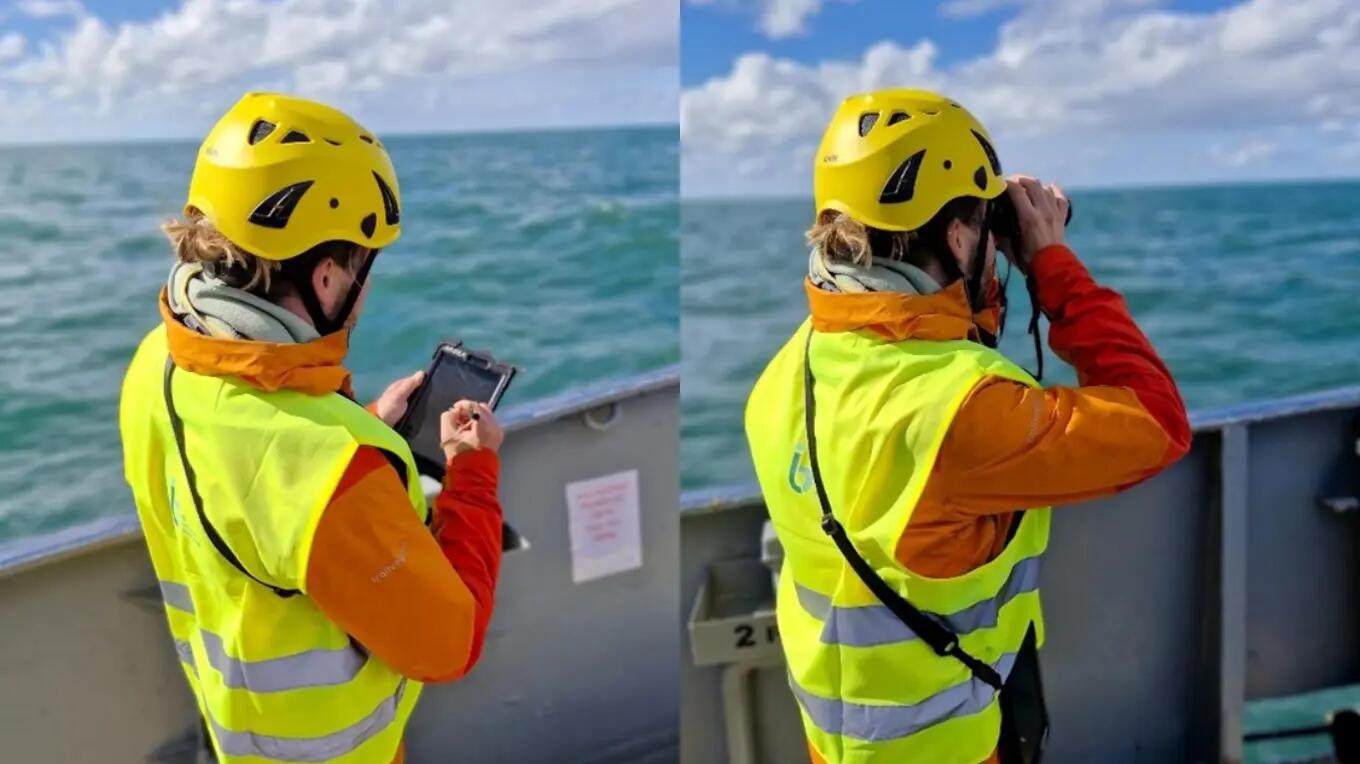
Our environmental monitoring extends above the waterline. Expert observers conduct visual surveys from both ships and aircraft, following systematic transects across the project area.
Onboard our vessels, trained ornithologists and marine mammal specialists work from wind-protected observation stations, known as “Orniboxes,” to record sightings. These observations provide valuable data on species abundance, behavior, and seasonal patterns.
.webp?t=resize&width=0.88)
Tracking Migratory Birds and Bats
Migratory species are particularly sensitive to offshore infrastructure. To monitor bird migration, we deploy radar systems on anchored vessels. While radar tracks flight paths and densities, species identification is carried out by ornithologists through:
- Daytime visual observations
- Nighttime acoustic monitoring of bird calls
In the Baltic Sea, we also monitor bat migration using ultrasonic detectors. These devices capture high-frequency calls, helping us understand bat activity over open water and implement protective measures where needed.
Future prospects for offshore wind power
Offshore wind power is continuously evolving. New technologies and international projects are expanding the possibilities for efficient, low-CO₂ electricity production.
Floating Offshore Wind Power
- Definition: Wind turbines on floating foundations for deep waters (>60 m).
- Advantages: More flexible site selection, less impact on the seabed, potential for regions with high wind speeds far from the coast.
- Future potential: Significant growth market in Europe, Asia, and the USA.
Sector coupling & storage solutions
- Integration of offshore power into hydrogen production, energy storage, and smart grids.
- Contribution to grid stability and security of supply.
Conclusion – Offshore Wind Power with TotalEnergies
Offshore wind power is a key pillar of the energy transition, providing businesses and society with low-CO₂, reliable electricity. TotalEnergies combines technology, experience, and environmental expertise to efficiently develop and operate offshore wind farms.

Join Our Team in Hamburg!
"Offshore wind energy plays a key role on Germany's path to a sustainable energy future. TotalEnergies wants to accompany this path with its 6,5 GW (netto)commitment in Germany. With its ideal wind conditions and strong political support, Germany is one of our target markets for renewable energy“
“I’m grateful to be part of the transformation of my company towards procuring better energy to our customers.”